
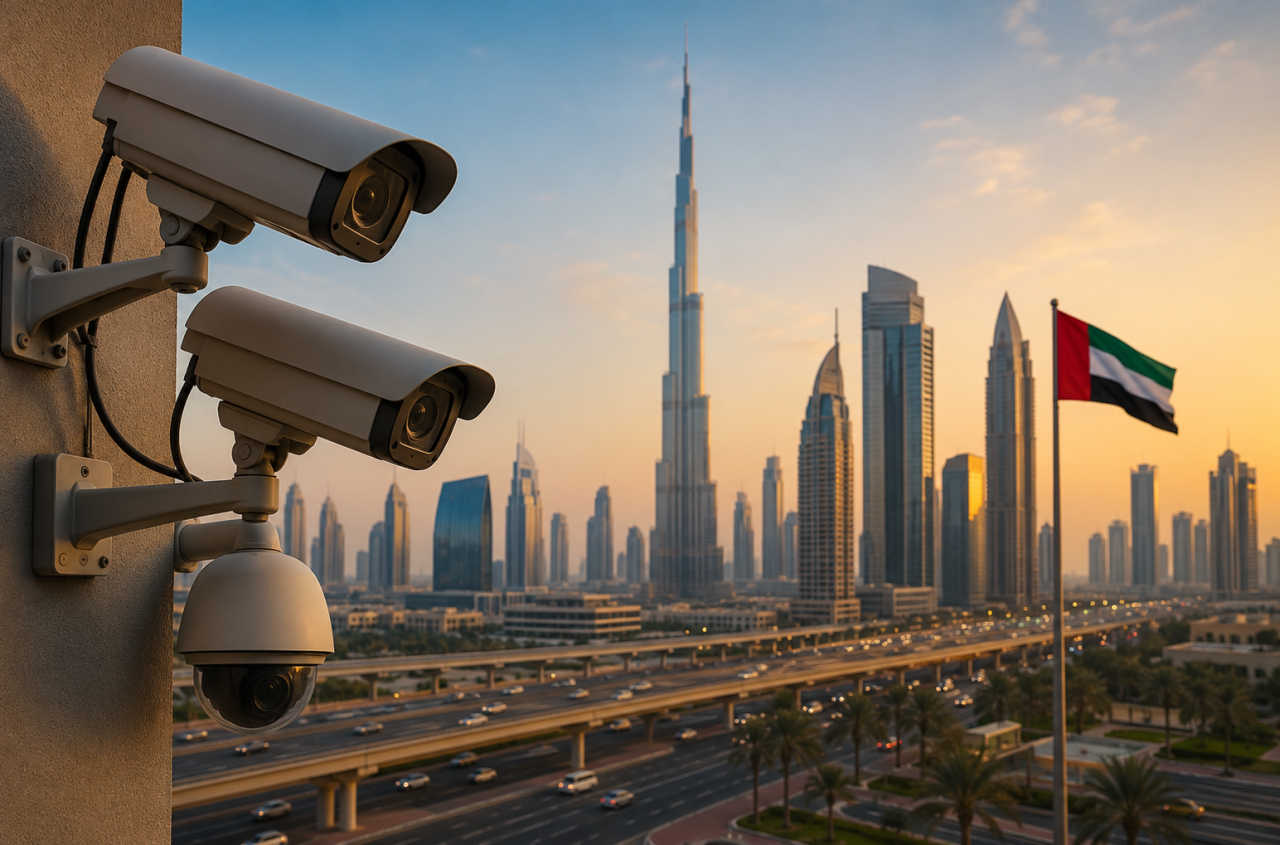
CCTV laws in Dubai is the main focus of this guide, and the sections below explain it in detail.
Dubai has not earned its place as one of the safest cities on earth through sheer luck alone. Behind its low crime rates and fast emergency response times lies a tightly regulated surveillance ecosystem, one which every business owner, facility manager, and property developer in Dubai must understand before placing even one camera on a wall.
If you’re new to researching Dubai CCTV regulations or trying to understand why your installation was flagged during inspection, this guide covers everything: who regulates CCTV systems in Dubai and their requirements under law; how to obtain approval; as well as selecting an installer who won’t leave you scrambling before licensing deadlines arrive.
Who Regulates CCTV in Dubai?
Dubai’s Security Industry Regulatory Agency, or SIRA, oversees every commercial or high-security camera installed within Dubai’s borders for commercial or high-security use. SIRA serves as the government body responsible for licensing and overseeing private security providers across Dubai; their mandate encompasses more than just guards or alarm systems; their jurisdiction extends even to cameras watching your storefront, recorders storing footage, and the companies you hire to install both systems.
Think of SIRA less as a bureaucratic checkbox and more as the quality gate that ensures Dubai’s surveillance network remains reliable. A camera system not in compliance with SIRA may pose both legal risks and inefficiencies that might limit its ability to deliver footage when needed most.
SIRA may only regulate security industry operations within Dubai, but similar oversight exists throughout the UAE; businesses operating across multiple emirates should expect similar, yet not always identical, rules to operate their businesses successfully.
Is CCTV Legally Required for Your Business?
Not every premises needs SIRA-approved CCTV, but a long list of business categories do, including:
- Warehouses, logistics hubs, and distribution centers
- Hotels and hospitality venues
- Banks and financial institutions
- Shopping malls and retail chains
- Gold, jewelry, and high-value goods shops
- Hospitals and healthcare facilities
- Residential towers and mixed-use commercial buildings
For these categories, CCTV compliance isn’t a nice-to-have. It’s frequently tied directly to trade license renewal, meaning a non-compliant system can hold up your entire business operation — not just your security posture.
The CCTV Legal Requirements Dubai Businesses Need to Know
Regulations get updated periodically, but the framework businesses should plan around generally covers six areas:
1. SIRA-certified equipment only. Cameras, recorders, and storage hardware all need SIRA certification. Installing uncertified equipment — even high-quality equipment — is one of the fastest ways to fail an inspection.
2. Strategic, privacy-aware placement. Cameras are required at entry points, exits, and high-risk areas, while private zones such as restrooms and prayer rooms must stay out of frame. Coverage and privacy aren’t competing goals under SIRA — they’re both mandatory.
3. Image quality standards. Footage needs to be clear enough to be useful in an investigation, with sharper resolution expected in sensitive zones like cash counters, server rooms, and main entrances.
4. Defined data retention periods. Footage must be securely stored for a minimum period set by regulation, with higher-security facilities often required to retain data considerably longer than standard retail or office premises.
5. Cybersecurity built in, not bolted on. Modern CCTV systems are network devices, not standalone boxes. SIRA increasingly expects encrypted footage, controlled access, and protection against remote tampering — CCTV security is now treated as an IT security issue as much as a physical one.
6. Ongoing maintenance responsibility. Approval at installation isn’t the finish line. A camera that goes offline or a recorder that silently stops saving footage is still a compliance failure, even years after your original SIRA sign-off.
How CCTV Camera Permission in Dubai Actually Works
Getting from “we need cameras” to “we’re fully licensed” typically follows this path:
- Scope the system based on your business category, floor plan, and risk areas.
- Bring in a SIRA-approved CCTV installation company to design a system around current technical standards — not last year’s, not a generic template.
- Submit your application to SIRA with full system specifications and installation documentation.
- Pass inspection, confirming the installed system matches exactly what was approved on paper.
- Receive SIRA certification, which most businesses need alongside — or as a condition of — their trade license.
The step most businesses underestimate is the first one. A system designed without a proper site assessment almost always needs costly rework later, whether that’s added cameras, repositioned units, or a full re-submission.
Why the Installer You Choose Matters More Than the Cameras Themselves
Not every security vendor in Dubai is authorized to install CCTV for regulated businesses, and this is where most compliance headaches actually start. A genuinely SIRA-approved CCTV company brings three things a generic installer can’t:
- Up-to-date technical knowledge, so you’re not installing equipment that’s already outdated by the time it’s inspected.
- Correct documentation, submitted the way SIRA expects it — the difference between a same-week approval and a months-long back-and-forth.
- Placement expertise that satisfies both coverage requirements and privacy law, which is harder to get right than it sounds.
Cutting corners on installer selection to save a few dirhams almost always costs more later — in failed inspections, wasted hardware, and delayed operations.
What Happens If You Don’t Comply
Skipping proper CCTV approval isn’t a quiet risk. Non-compliance in Dubai can lead to:
- Direct financial penalties
- Delayed or rejected trade license renewals
- Complications with insurance claims after an incident
- Increased legal exposure if footage is unavailable, low quality, or missing entirely during an investigation
Given how tightly CCTV compliance is now woven into licensing and operations, it’s not a task worth deferring.
Frequently Asked Questions
1. Can I install my own CCTV system in Dubai, or does it have to go through an approved company?
Technically, you can purchase and mount cameras yourself — but for any business in a regulated category (retail, hospitality, warehousing, healthcare, and similar), self-installation almost never passes SIRA approval. That’s because SIRA doesn’t just check whether cameras exist; it checks whether the specific equipment, placement, and documentation meet its certified standards. A DIY system built without that framework in mind typically needs to be partially or fully reinstalled by a licensed provider anyway, which ends up costing more time and money than starting with an approved installer. This is exactly the gap Logical Network Solution closes — handling design, SIRA-compliant equipment selection, and installation as one process, so nothing needs to be redone later.
2. My CCTV system is a few years old — how do I know if it still meets current SIRA standards?
Regulations are revisited periodically, and standards around resolution, retention periods, and system cybersecurity tend to tighten over time rather than loosen. A system that passed inspection three or four years ago may no longer meet today’s baseline, particularly around footage encryption and remote access controls. The most reliable way to check is a compliance audit against the current SIRA framework rather than assuming your original approval still holds. Logical Network Solution offers exactly this kind of assessment — reviewing existing installations against present-day requirements and recommending targeted upgrades instead of a full costly replacement wherever possible.
3. What’s the difference between a “security camera company” and a “SIRA-approved CCTV company” in Dubai?
A general security camera company can sell and install hardware, but that doesn’t mean the installation is legally recognized for regulated businesses. A SIRA-approved company has gone through its own licensing process with the agency, meaning its installations, equipment sourcing, and documentation are built specifically to satisfy SIRA’s inspection criteria — not just to get a system technically working. For any business where CCTV compliance is tied to a trade license, this distinction is the difference between an approved system and one that has to be redone. Logical Network Solution operates as a SIRA-approved provider, which means the systems it installs are designed to pass inspection the first time, not adjusted after a rejection.
Why CCTV laws in Dubai Matters
CCTV laws in Dubai plays an important role in the topics discussed throughout this guide.