
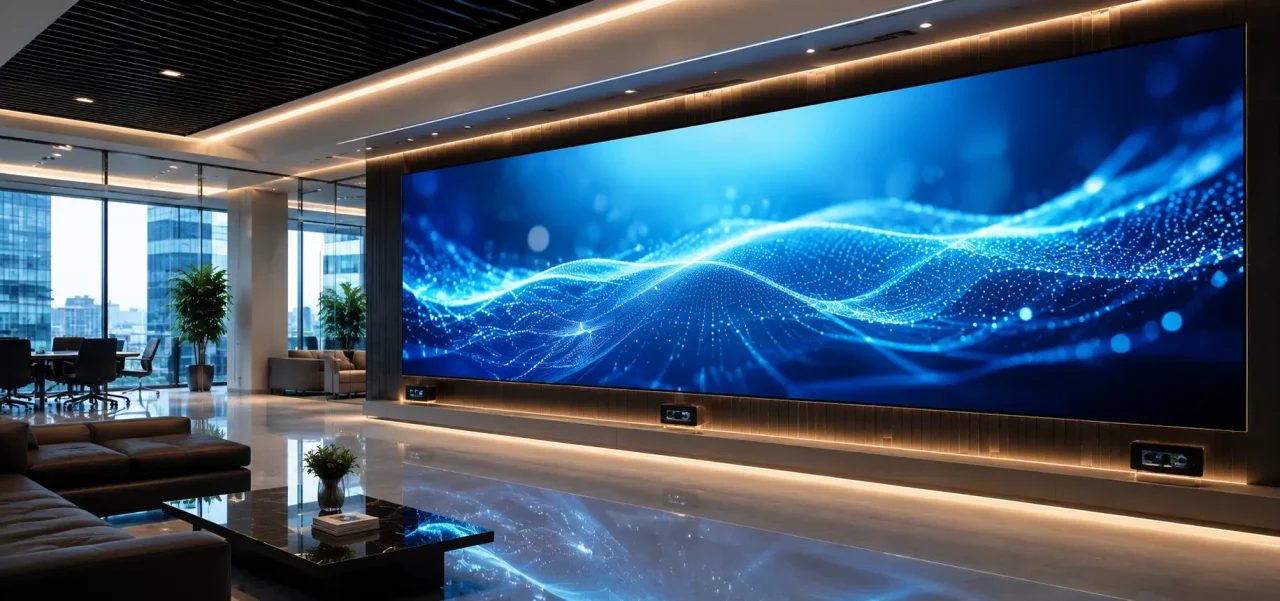
Video Wall Installation Services is the main focus of this guide, and the sections below explain it in detail.
Walk into any modern control room, retail flagship, corporate lobby, or live event and it’s likely you’ll see a video wall performing some of its heavy lifting – be it data display, branding or spectacle at a scale that one screen simply cannot match. But getting it just right requires careful planning well ahead of installation day – not simply buying big screens but rather engineering an effective display system to fit both space, use case, and people relying on it.
This guide describes what commercial video wall systems entail, where they’re commonly employed and how you can select appropriate solutions for your project.
What Is a Video Wall, Really?
A video wall is a large-format display comprised of multiple screens, typically LED panels or LCD tiles, connected together and controlled as one single visual surface. When designed effectively, its seams between panels become invisible, and the wall reads as one continuous image, whether that be live dashboard data, brand background visuals for events or cinematic visuals for movie premieres.
Installation matters just as much as the technology behind it, which can quickly turn an impressive display into an endless source of problems. That’s why video wall installation services typically involve end-to-end projects involving design, hardware selection, structural mounting, calibration and content integration — rather than simply “placing a screen on a wall”. Where Are Commercial Video Wall Systems Used?
Control Rooms
Video walls for control rooms are more about operational clarity than visual impact. Security operations centers, network operations centers, transportation hubs and utility monitoring facilities all rely on video walls to display multiple live feeds, dashboards and alerts simultaneously in one consolidated view versus individual monitors scattered around. Reliability, uptime and 24/7 duty cycles take precedence here rather than raw spectacle.
Corporate and retail environments
Indoor video wall solutions have become an increasingly popular addition in lobbies, showrooms, and retail flagships, where brands use large-format displays to reinforce identity, showcase products, or guide visitors. Here, visual polish becomes paramount – such as accurate colors, seamless tiling and intentional content rather than stretched or pixelated displays.
Live events
An LED video wall for events needs to handle a different set of demands entirely: rapid setup and teardown, portability, high brightness for varied lighting conditions, and the visual punch to hold attention in a crowded room or outdoor venue. Concerts, conferences, product launches, and trade shows all lean on event-grade LED walls for exactly this reason.
Command centers and large-format displays generally
A large screen video wall isn’t defined by one industry — it’s defined by the need to display information or visuals at a scale and clarity that individual monitors can’t achieve, whether that’s a boardroom, a broadcast studio, or a transportation command hub.
LED Video Wall Installation: What Actually Goes Into It
LED video wall installation is a more technical process than most people expect. A properly executed installation typically involves:
1. Site assessment and structural planning: Every wall, floor, or truss has weight and mounting limitations. Installation teams need to confirm the structure can safely support the display — including the mounting frame, cabling, and any moving or rigging components for event use.
2. Pixel pitch selection: Pixel pitch determines how close viewers can get to the display before individual pixels become visible. Control rooms and up-close retail displays generally call for a finer pixel pitch, while large venue walls viewed from a distance can use a coarser pitch without any perceived loss in quality.
3. Panel alignment and calibration: Even high-quality panels need color and brightness calibration across the entire wall so the image reads as one continuous surface rather than a visible grid of individual tiles.
4. Processing and content management: A video wall processor takes incoming content — live feeds, dashboards, media, or graphics — and maps it correctly across every panel. This is where a lot of amateur installations fall apart: without proper processing hardware, scaling and synchronization issues become obvious fast.
5. Cable management and redundancy: For mission-critical environments like control rooms, redundant power and signal paths are often built in so a single cable or power failure doesn’t take down part of the display.
6. Testing and handover: A proper installation is tested under real operating conditions — full brightness, full content load, extended runtime — before it’s handed over, not just switched on and checked visually for a few minutes.
Display Wall Systems: Choosing the Right Type for Your Space
Not every project needs the same technology. Broadly, display wall systems fall into a few categories:
- Fine-pitch LED walls — ideal for control rooms and up-close viewing where clarity at short distances matters most.
- Standard LED walls — a strong fit for retail, lobbies, and general commercial use where viewing distance is moderate.
- Event-grade LED walls — built for portability, rapid deployment, and high brightness output.
- LCD video walls — often used where budget or space constraints make LED less practical, with the tradeoff of visible bezels between panels.
Choosing the wrong category for the use case is one of the most common — and most expensive — mistakes businesses make when planning a video wall project.
Why Professional Installation Matters More Than the Hardware Itself
It’s tempting to think of a video wall as a hardware purchase, but the panels themselves are only part of the equation. The difference between a video wall that performs flawlessly for years and one that becomes a maintenance headache almost always comes down to installation quality — proper structural mounting, correct processor configuration, calibrated color and brightness, and a design that accounts for how the space will actually be used day to day.
This is exactly why video wall installation services are typically sold as a full project rather than a parts list. The planning, structural work, and calibration are where the real expertise shows.
Video Wall Installation Services from Logical Network Solution
Planning a video wall — whether it’s for a control room, a corporate lobby, a retail space, or a live event — comes down to getting the design, hardware, and installation right the first time. Logical Network Solution provides end-to-end video wall installation services, including:
- Site assessment and structural planning
- LED and LCD video wall system design
- Pixel pitch selection and equipment sourcing
- Full installation, calibration, and processor configuration
- Ongoing maintenance and support for control room and commercial installations
If you’re planning a new video wall or need to evaluate an existing display system, get in touch with Logical Network Solution to discuss what your space and use case actually require.